2026 Rate Change FAQ's
Like many businesses, Pella Cooperative Electric Association is experiencing higher costs for the equipment and materials needed to operate and maintain the electric system. This includes items like poles, wire, transformers, and trucks, along with the labor and services required to keep everything running safely and reliably. Over the past several years, the cost of these everyday items has increased significantly.
In addition to those local costs, the cost of power we purchase from our wholesale supplier has also increased. While that cost is largely passed through, it still contributes to the overall cost of providing electric service.
Electric utilities must maintain and invest in their systems regardless of short-term conditions. Like other utilities, we periodically adjust rates to keep up with rising costs and ensure we can continue providing safe, reliable electric service to all members.
No. This rate adjustment is not driven by data centers or any specific new large electric load.
The change is based on the cooperative’s overall cost of providing service, including the cost of power, materials, equipment, and maintaining the electric system. These costs have increased over time and affect all members.
While large new electric loads are sometimes discussed in the broader electric industry, they are not a factor in this rate change.
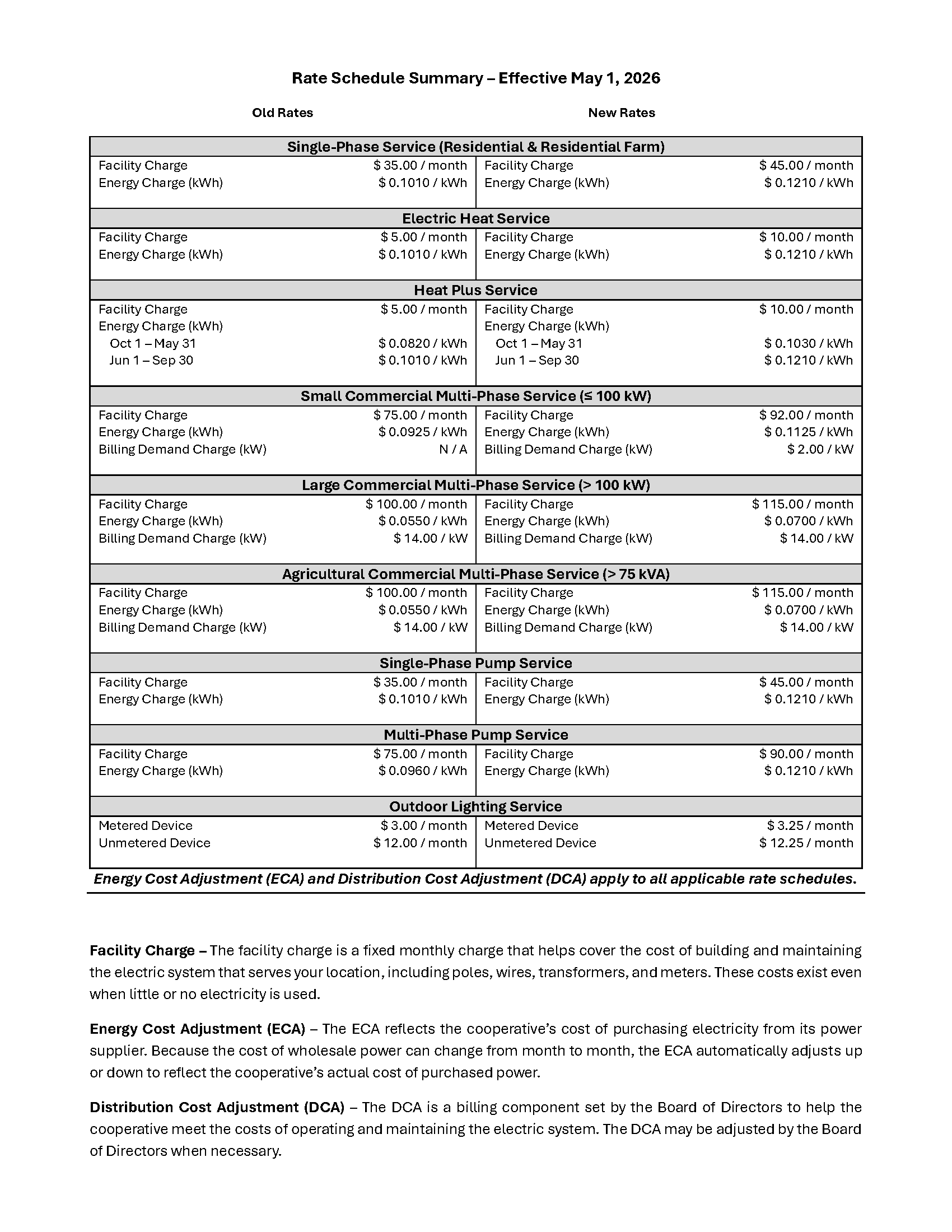
The impact of the rate change will vary depending on how much electricity you use and, for some members, how and when that electricity is used. Because every home and business is different, there is not a single increase that applies to everyone.
To help provide context, we’ve included average monthly bill impacts by rate class below. These examples are based on typical usage levels and are intended to give a general idea of how bills may change.
Your actual bill may be higher or lower than the averages shown, depending on your specific usage patterns.
| Rate Class | Current Average Monthly Bill | New Average Monthly Rate Increase (Decrease) | New Average Monthly Bill | Percentage Change |
|---|---|---|---|---|
|
Single-Phase (Residential/Farm) |
$ 167.33 | $ 12.55 | $ 179.87 | 7.5 % |
| Heat Rate | $ 98.80 | $ 4.99 | $ 103.79 | 5.0 % |
| Small Commercial | $ 568.67 | $ 43.53 | $ 612.19 | 7.7 % |
| Ag Commercial (Grain Handling & Storage) | $ 839.63 | ($ 1.55) | $ 838.08 | (0.2 %) |
| Single-Phase Pump | $ 76.07 | $ 11.05 | $ 87.12 | 14.5 % |
| Multi-Phase Pump | $ 183.40 | $ 22.76 | $ 206.16 | 12.4 % |
Some agricultural operations, particularly larger grain facilities, use electricity in ways that are different from typical residential, farm, or small commercial accounts. These operations often have higher and more concentrated usage during certain times of the year.
To better reflect those differences, the cooperative created a separate Ag Commercial rate class. This allows rates for these accounts to more closely match how they use the electric system and what it costs to serve them.
This rate class generally applies to larger agricultural services, typically those served by transformer capacity greater than 75 kVA. On your bill, these accounts are identified with a rate code such as “MP>75.” This does not apply to most single-phase farm accounts.
If your account falls into this category, this does not change the service you receive, but it may change how your bill is calculated based on your usage patterns.
If you are unsure whether your account is included in this class, please contact our office and we can walk through your account with you.
The average bill change shown in the rate notice is based on a typical level of electricity use for each rate class. Your actual bill may be higher or lower than the average shown depending on your specific usage patterns and the rate that applies to your account.
Seasonal factors, such as heating or cooling needs, can also affect how your bill changes from month to month.
For small commercial members, demand may also affect the bill. Demand is based on the highest level of electricity used at one time during the billing period, so businesses with different usage patterns may see different impacts even if their total monthly energy use is similar.
Because every home and business uses electricity differently, the average provides a general estimate, but your bill will reflect your actual usage.
Pella Cooperative Electric Association continually works to manage costs and operate as efficiently as possible. This includes carefully planning system improvements, prioritizing necessary maintenance, and making thoughtful decisions about when and where to invest in the electric system.
We also focus on controlling operating expenses by managing day-to-day costs, maintaining equipment to extend its life, and using our resources as efficiently as possible. These efforts are part of our normal operations and are ongoing, not just in response to a rate change.
At the same time, the cost of materials, equipment, and power needed to operate the system has increased over time. The current rate adjustment reflects the point where those increases can no longer be fully absorbed while continuing to maintain safe, reliable electric service.
Electric rates are designed to recover the cost of providing service to members. This includes the cost of power, operating and maintaining the electric system, and meeting the financial requirements of the cooperative.
To ensure rates are fair and aligned with actual costs, Pella Cooperative Electric Association periodically conducts a cost of service study. This analysis evaluates how different types of members use the system and helps determine how costs should be allocated across rate classes.
Based on this information, proposed rates are developed and reviewed. Final approval of all rates is the responsibility of the cooperative’s Board of Directors, who are locally elected by the membership and represent the interests of the communities we serve.
Electric rates are designed so that each group of members pays an appropriate share of the cost to provide service. To help guide this update, the cooperative completed a cost of service study that looks at how different types of members use electricity and what it takes to serve them.
The study helps us make sure rates stay aligned with today’s system and usage patterns. As part of that process, some rates are going up while others are going down.
This is not about shifting costs from one group to another. It’s about keeping rates balanced over time so they continue to reflect how electricity is used and what it costs to provide reliable service.
Our goal is to treat all members fairly and keep rates aligned as conditions change.
The most effective way to manage your electric bill is to be mindful of how and when electricity is used. Reducing overall energy use will continue to help lower your bill, including actions such as improving insulation, maintaining heating and cooling systems, and using energy-efficient equipment.
For small commercial members, both total energy use and how that energy is used can affect the bill. In addition to reducing overall usage, spreading out the use of large equipment can help avoid high peaks in demand.
While the rate structure is changing, the same general principles still apply. Using electricity efficiently and avoiding unnecessary usage remain the best ways to manage your bill over time.
A demand charge reflects the highest level of electricity used at one time during the billing period. It is typically measured as the average usage over a 15-minute interval.
Demand charges are common for commercial electric service because businesses often operate equipment that requires large amounts of electricity at certain times. The electric system must be built to handle these higher levels of use, even if they occur for a short period.
Adding a demand charge helps align rates more closely with how the electric system is used and ensures that costs are more fairly distributed based on both total energy use and peak demand.
Demand is driven by how many pieces of equipment are operating at the same time. One of the most effective ways to manage demand is to avoid running multiple large pieces of equipment simultaneously when possible.
For example, staggering the start-up of motors, compressors, or other large equipment by more than 15 minutes can help reduce your peak demand. In some cases, adjusting operating schedules or shifting certain activities to different times of day may also help.
Not all businesses will have flexibility in how equipment is used, but for those that do, small adjustments in timing can make a meaningful difference.
If you have questions about your bill, rates, or electric service, we encourage you to contact our office directly. Our team is available to walk through your bill, explain how charges are calculated, and discuss your specific situation.
You can reach us at service@pella-cea.org or 800-619-1040. We are always happy to help and want to make sure you have the information you need to understand your electric service.