
Report from Duane Ver Ploeg, Representative on the CIPCO Board of Directors
 As a representative of Pella Cooperative Electric Association on the Central Iowa Power Cooperative Board of Directors, I’ve had the opportunity to see firsthand the significant progress CIPCO made in 2025 to strengthen the reliability and future of our power supply system. In recent years, CIPCO has been committed to pursuing cooperative solutions to the generation challenges facing us. Today, that commitment is turning into action.
Guided by its Integrated Resource Plan, CIPCO moved forward with several major generation projects last year that will help meet growing energy demand, support economic development, and ensure long-term reliability for the communities it serves. Together, these projects will add nearly 400 MW of generation resources to CIPCO’s portfolio in the years ahead.
One of the most important developments was the announcement of a new 240 MW natural gas-fired peaking facility in eastern Iowa. This plant will provide dependable energy during periods of high demand and help balance intermittent resources like wind and solar generation. Significant progress has already been made and, once completed, the plant will become the largest capital project in CIPCO’s history and a critical reliability resource for PCEA.
CIPCO also reaffirmed its commitment to the Coggon Solar project, a 100 MW solar facility in Linn County. After overcoming regulatory and legal hurdles, the project is now moving forward with construction expected to begin soon and completion targeted for 2028. This project reflects CIPCO’s continued commitment to a balanced, all-of-the-above generation strategy.
Another major milestone came with the announcement that Duane Arnold Energy Center, Iowa’s only nuclear facility, will return to service through a collaboration involving CIPCO, NextEra Energy, and Google. CIPCO secured a long-term agreement to purchase a portion of the plant’s output once operations resume in 2029. Nuclear energy has long played an important role in Iowa’s energy mix, and restarting DAEC will provide CIPCO Member-owners like PCEA with reliable, carbon-free baseload generation for decades to come.
CIPCO’s strong financial performance in 2025 also demonstrates responsible stewardship of member resources. Strong margins allowed CIPCO to defer revenue and create financial flexibility that will help maintain stable and affordable rates while these major investments move forward. Both Standard & Poor’s and Fitch Ratings affirmed CIPCO’s ‘A’ rating as a result of this financial strength. In 2025, CIPCO realized a net margin of $28 million, well ahead of budget. This in turn allowed margins to be returned to CIPCO Member-owners in the form of patronage, a key component of the cooperative business model. For 2025, CIPCO returned patronage totaling $210,225 to our cooperative.
We are already seeing the impact of increased electric demand throughout our communities. CIPCO’s energy sales reached an all-time high in 2025, driven by growth and economic development opportunities across the system. With this in mind, CIPCO maintained an overall outage rate of 0.26 per consumer, well under the target of 1.00 hour per consumer. In 2025, PCEA’s was 0.89 hours per member.
At the heart of all this progress is cooperation. CIPCO exists to serve its Member-owner cooperatives, and these accomplishments reflect what can be achieved when cooperatives work together with a shared purpose. I am confident that together, CIPCO and Pella Cooperative Electric Association will remain steadfast in delivering stable power at stable rates today and in the decades to come.
_________________________________________________________
Represents 3,209 GWh requirements for traditional load
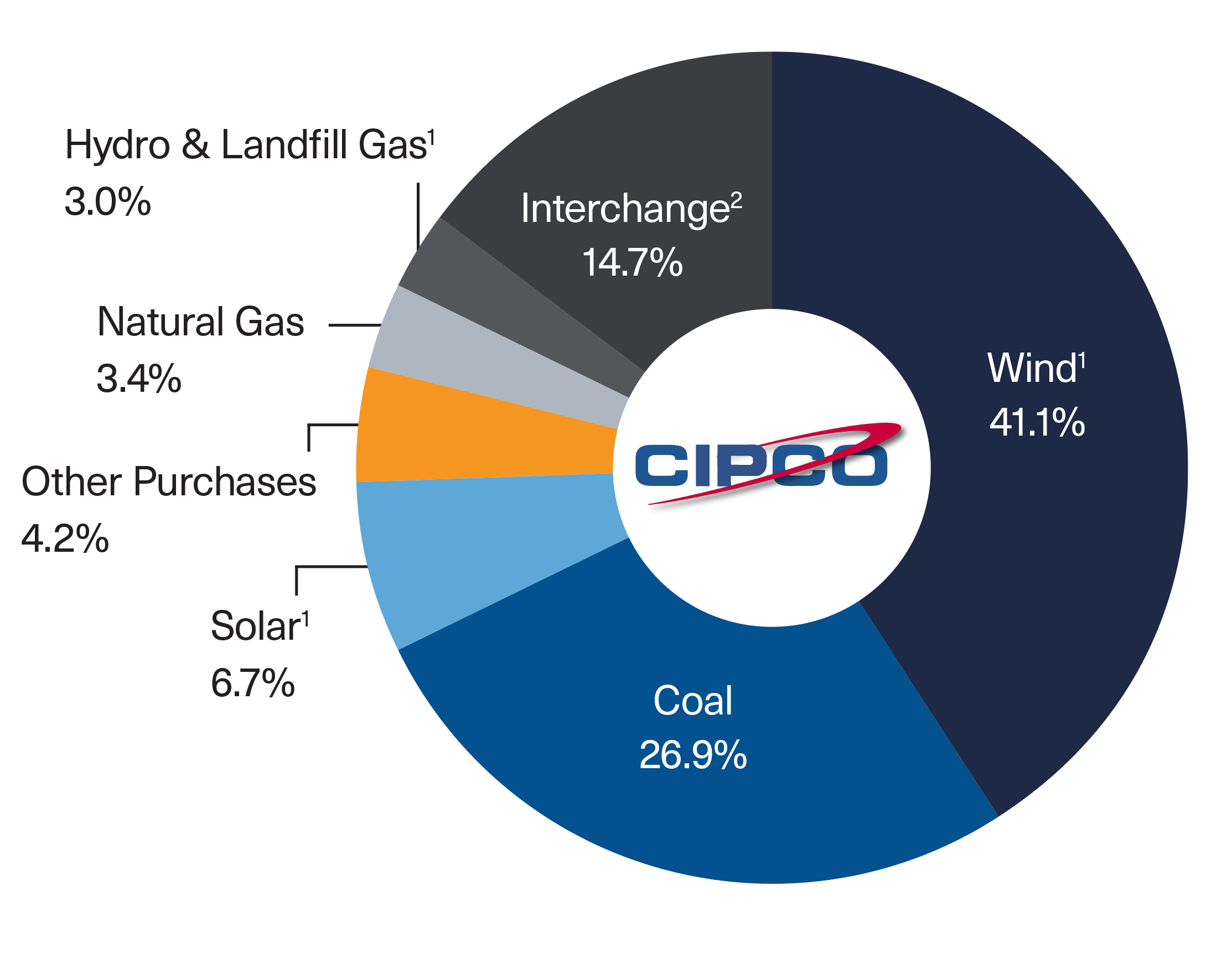 |
| 1CIPCO invests in the development of renewable energy projects in several ways. We operate six small-scale solar arrays near communities we serve and retain the renewable energy certificates associated with each. We also contract with energy producers for the electricity output from wind, solar, hydro, and methane gas from a landfill (converted into electricity). CIPCO cannot claim these resources as renewable within our supply portfolio as we have either sold to third parties or do not receive the renewable attributes associated with the electricity produced from these renewable power sources. By selling these attributes (RECs), we not only support other organizations in meeting their renewable energy goals, we also generate revenue to help us lower our wholesale power rate to our 12 Member-owner distribution cooperatives and 15 municipalities. 2A percentage of market purchases exist within the portfolio to meet additional supply needs not covered by existing contracts or CIPCO-produced generation. Weather volatility and unplanned operational events at power plants may also impact market purchases. |